开源数据
MGH Connectome Diffusion Microstructure Dataset (CDMD)Hardware: MGH-USC 3T Connectome scanner equipped with 300 mT/m maximum gradient strength, custom-built 64-channel head coil
Participant: 26 healthy participants, 7 out of 26 participants rescanned in the same day
Diffusion MRI Protocol: pulsed gradient spin echo sequence, 2 mm isotropic, two diffusion times (19 and 49 ms), 8 ms gradient duration,8 gradient strengths linearly spaced between 30 mT/m and 290 mT/m per diffusion time (i.e., 8 shells), 32 (b <= 3000 s/mm^2) or 64(b > 3000 s/mm^2) uniform directions per shell, 850 image volumes in total, 1 hour scan time, real-valued diffusion data available for14 outof 26 participants (including all 7 participants with rescan data)
Anatomical MRI Protocol: T1-weighted MPRAGE sequence, 1 mm isotropic (FreeSurfer reconstruction results available)
Additioanl Data: Please contact BIRTH Lab for unprocessed imaging data and/or demographic data
会议摘要
会议摘要 第一和通讯作者 2025 HUMMID: High-fidelity Ultra-fast Macr […]
合作论文
科学美国人 | Building a See-Through Brain;南方周末 | 点亮神经元,寻找记忆痕迹;斯坦福新闻 | Stanford research shows that different brain cells process positive and negative experiences
发表论文
发表论文 (#共同一作, *通讯作者) 2024 The Effects of Axonal Beading […]
受邀综述
受邀综述 (#共同一作, *通讯作者) Artificial Intelligence for Neuro M […]
书籍章节
书籍章节 (*通讯作者) Enhance the Image: Super Resolution in MRI […]
技术专利
技术专利 一种模型驱动的自监督深度学习磁共振图像重建算法 田启源,宋同羲 基于扩散先验的微结构模型优化方法、装 […]
媒体报道
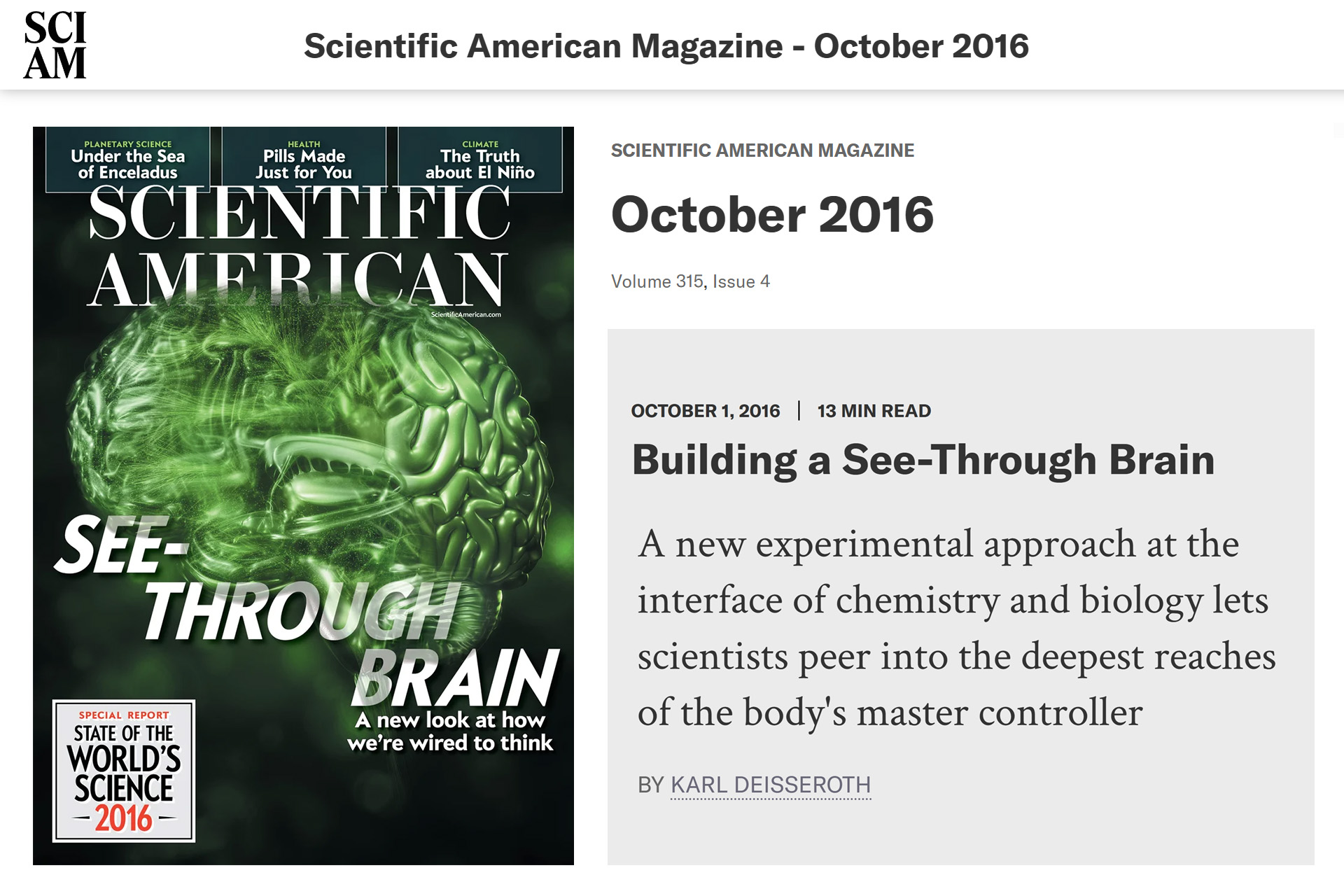
科学美国人 | Building a See-Through Brain;南方周末 | 点亮神经元,寻找记忆痕迹;斯坦福新闻 | Stanford research shows that different brain cells process positive and negative experiences
成果清单
Full list at PubMed, Google Scholar, Google Patents